Sunday, 3 November 2013

Isle of Eigg at Half-Term

Twilight.
Laig Bay, Isle of Eigg

Sunset
Laig Bay, Isle of Eigg

Sunset
Laig Bay, Isle of Eigg

Sunset
Laig Bay, Isle of Eigg

Sunset
Laig Bay, Isle of Eigg

Sunset
Laig Bay, Isle of Eigg

Sunset
Laig Bay, Isle of Eigg

Sunset
Laig Bay, Isle of Eigg

Me enjoying the sunset
Laig Bay, Isle of Eigg

Looking to Rum from Eigg at Twilight

Spinning some wool
Laig Bay, Isle of Eigg


Sailing to Eigg

Ishbel on the ferry to Eigg

Harriet realises she's in a Calmac Ferry cafeteria

All day breakfast in the Calmac Ferry cafeteria- my idea of heaven!

Mairi & Harriet in the ferry cafeteria

Approaching Eigg

Arriving at Eigg as foot-passengers

Ish & Al up a tree at Lageorna where we stayed

Lageorna, Eigg where we stayed for 4 nights

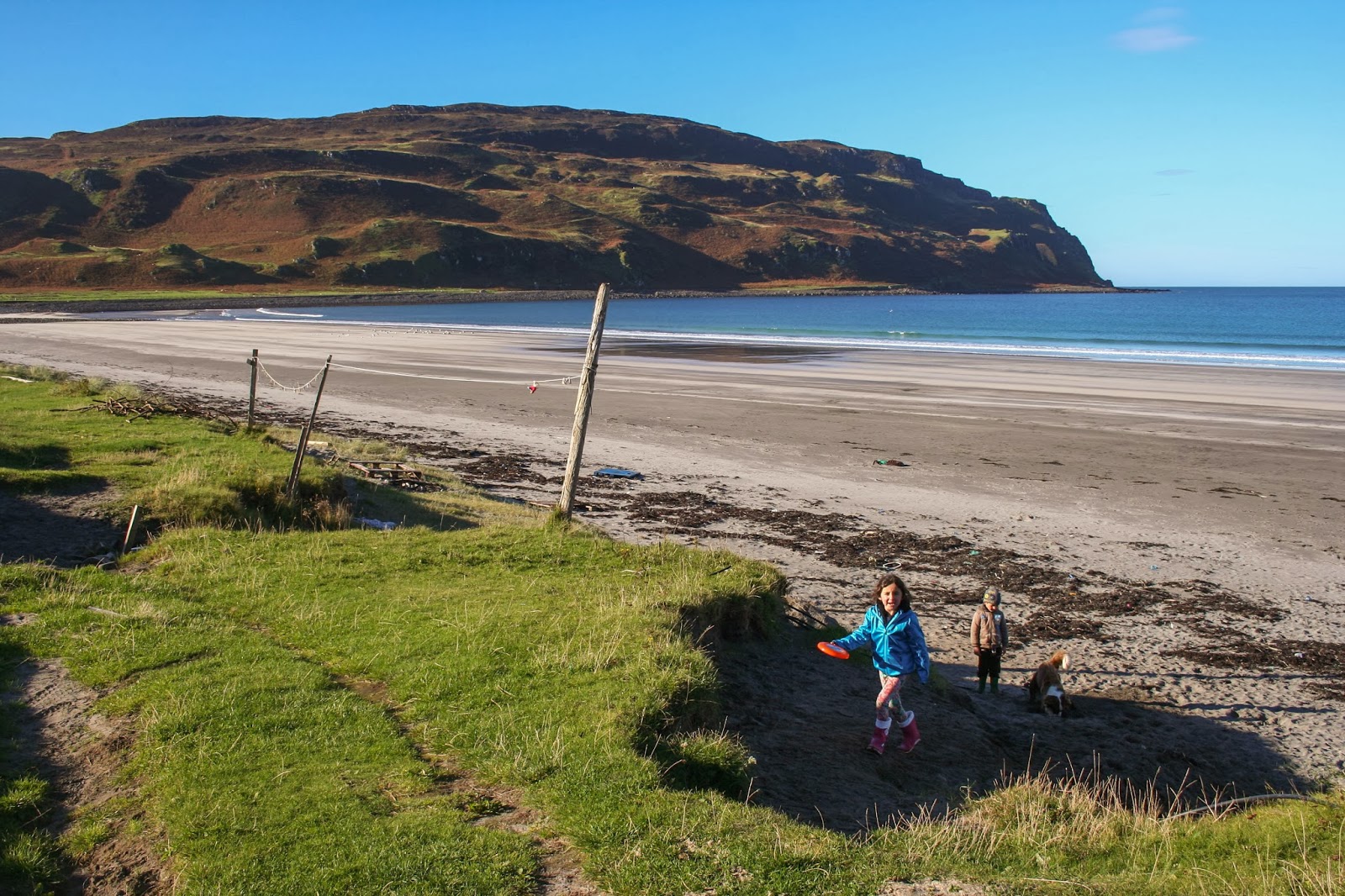
Heading down to the beach at Laig Bay

Ishbel & Alastair have the beach to themselves with one of the island's resident dogs


Laig Bay

Mairi & Harriet at Laig Bay

Alastair about to go for a dip- in October!

About to go for a swim

Swimming in the sea in Scotland in October!

Cold now

Harriet at Laig Bay

The track to Laig Bay at sunset

Sunset
Laig Bay, Isle of Eigg

Sunset
Laig Bay, Isle of Eigg


Exploring the beach

The weird geology of Laig Bay- known as The Jurassic Coast

Me with Harriet at Laig Bay

Ish & Al exploring the great, rocky coastline at Laig Bay

Ishbel at Laig Bay

Ish & Al at Laig Bay

Rum from Eigg at Twilight

Isbel in The Massacre Cave on Eigg where in the 16th century 400 MacDonnells of Eigg were killed by the MacLeods of Skye who lit a fire at the cave entrance and suffocated them with the smoke. Note the cave entrance way in the background(c100m away) and Mairi's tiny silhouette sat there with Harriet
The Massacre Cave on Eigg

In search of Cathedral Cave on Eigg where the catholic islanders would hold secret mass after the Reformation. It is only accessible at low tide

Cathedral Cave- nb Al and Mairi & Ishbel

Harriet has a nappy change in front of Cathedral Cave

Negotiating the shoreline back from Cathedral Cave

Walking back from the shop- nb Mairi & Ishbel lower right

Another fabulous sunset at Laig Bay, Isle of Eigg

Another fabulous sunset at Laig Bay, Isle of Eigg

The Eigg Postman's House at Laig Bay, Isle of Eigg at night with stars overhead and Rum's dark silhouette. The bright light to the left of Rum's profile is the lighthouse at Heskeir

Mairi and the children heading for The Singing Sands beach on Eigg

Mairi and the children heading for The Singing Sands beach on Eigg

Mairi and the children at The Singing Sands beach on Eigg

Mairi and the children at The Singing Sands beach on Eigg. The sand is made from angular crystals of quartz and they do sing! (But they don't do requests- we tried! They make a sort of squeaking sound if you scuff your feet)

Mairi and the children at The Singing Sands beach on Eigg

Mairi and the children at The Singing Sands beach on Eigg

Ishbel at The Singing Sands beach on Eigg

 The Singing Sands beach on Eigg

The Singing Sands beach on Eigg

Me with Harriet at The Singing Sands beach on Eigg

Al loves the classics- The Singing Sands beach on Eigg

The Singing Sands beach on Eigg

Saturday, 1 June 2013

noctilucent clouds


noctilucent clouds 23:24BST at newark pier, port glasgow
another from thursday night at 23:24BST. as i was preparing to leave about 11pm BST these strange, wispy, ethereal, white clouds appeared mysteriously & wraith-like in the sky above the pier. it turns out they are noctilucent clouds. they are 'the most exotic clouds in the sky' and are also the highest- at 80,000-85,000' they are on the very edge of space and represent ice crystals that are still catching the sun's light although it has dipped below the horizon so that lower clouds are in shadow. as such they are only seen in summer and between latitudes 50°-70°. by comparison the other highest clouds seen in the uk are cirrhus which are c11,000'.
read more about them here:
http://en.wikipedia.org/wiki/Noctilucent_cloud
and for a rather fine 3min audio slide show from the bbc see here:
http://www.bbc.co.uk/news/science-environment-10635796

and here are some of the other photos I took:


I looked at the heron and it looked at me as we both stood stock still by the water's edge watching the sun set behind the Cowal Hills in Argyll in an impressive display of beauty & colour.


Sunday, 26 May 2013

The Clyde Timber Ponds

—

Unable to resist the lure of this settled weather and the promise of a full moon rising I nipped out late last night and found myself down by the rotting, wooden piles of the old timber ponds on the Clyde. Two tug-boats plied their way upriver towards the city & somewhere behind me a gang of neds laughed round a bonfire & fed it with wood.


                                                                  The timber ponds extend along the estuary mudflats from Kelburn in Port Glasgow to Langbank, a distance of around three miles and are the remains of wooden enclosures or ‘ponds’ erected in the early 18th century to store and season timber imported from Europe and North America for Greenock's Ship building industry. Timber including pitch pine, yellow pine and oak were in great demand by the local shipbuilders in Port Glasgow.
The ponds fell into disuse in the early 19th century. They were a source of income to the local landowners who rented out the shoreline for this purpose.
The wooden poles date from the 18th century when shipbuilding on the Clyde began in earnest in turn triggering a huge demand for timber. The timber was imported from North America in specially designed vessels fitted with bow doors. The imported wood was discharged into the Clyde and stored in the timber ponds until needed for ship construction. The seawater environment both seasoned and preserved the logs. This timber trade declined due to a combination of (a) dredging of the Clyde which provided a deep water access to Glasgow and (b) switch from wooden to iron ship construction. Last wooden ship was built on the Clyde in 1859.
.


Friday, 24 May 2013

In Search Of The Perfect Point Of View

Douglas Collinson. Another from Friday night... here Doug surveys the grand scene around him from a perch on a boulder while his camera records another long exposure.
We waded gingerly but still the cold water dribbled over the tops of our boots and soaked our feet.
 
i was up at loch lomond with doug last night. conditions were sublime. the whole experience was like an advert for "visit scotland". we passed a couple of wedding guests sat on a bench in the sunshine drinking in the tranquillity of the scene before them. later, as we waded out into the loch to take photos (with wellies taking in water unpleasantly), we could hear the strains of the the wedding band going through the old stock favourites- doug wondered how long it would be before they did a 'creedence clearwater' number. answer? 3 tracks! bats flitted about our head and the muffled sound of ducks' wing-beats drifted low across the surface of the loch to where we stood. scotland! yer cannae beat it!


Saturday, 18 May 2013

The Renfrew Ferry

The Stillness of Evening At The Renfrew Ferry
I headed down to the Renfrew Ferry on Thursday evening to catch the sunset. I love these types of structures. The one shown here is the northern end of the Renfrew Ferry which is a short passenger ferry crossing the River Clyde from Yoker to Renfrew. A ferry has operated in this area since the early 1600s. It remained a chain ferry until the mid1980s & this structure was for supporting the chain mechanism
Like a lot of the Clyde it is well past it's best- those days when this area was a hive of shipbuilding with several ferries like this crossing the Clyde carrying workers to and from the numerous shipyards either side of the river. Still it's a nice, reflective spot to hang out at the end of the day with the small boat's engines breaking the stillness and carrying dad's with wee kids and young couples from one side of the river to the other. While I was there the lovely soft, muffled wing-beat sound of 2 swans in flight heading down the river added to the moment.

Sundown At The Renfrew Ferry
3 portrait picture stitch
each photo 8second exposure, f16, ISO 100,18mm
using polariser, nd12 & nd0.6 soft grad filters


A ferry service had begun by 1614 although the  first public ferry boat was reported to be in use by 1710  between King's Inch and Blawarthill on the north bank. In 1782 Alexander Speirs, a Glasgow tobacco merchant, built a mansion on the King's Inch. The path to the ferry  now ran through his property. In 1787 the family asked  if the ferry could be moved half a mile west, offering in return to build two quays, a ferry house and a new road, the now known Ferry road. The ferry Inn was opened in 1789 and by 1791 the ferry was operating from its new site.
 The ferries still used ropes or chains fixed on each bank, at first hauled but hand, but from 1868 by steam-power. Larger boats were built in 1897 ad 1912. The ferry was used for mostly workers traveling to the shipyards and factories on both sides of the river. The ferry proved of great use during the war of 1941 to bring fire-engines to Clydebank from Renfrewshire during the bombing.
 By the year 1953 the ferries were not used as much as the shipyards and factories were closing down. By the early 1970's most motorists used the Clyde tunnel and Erskine bridge to cross the Clyde. Thus the decision to end the vehicle Ferry in 1984 and it became a passenger ferry.
 One of the older Ferries is now docked in Glasgow being used as a music venue.
 Renfrew Ferry has run for centuries, transporting passengers across the River Clyde to Yoker. As recently as 1984 a chain operated service was still in use. This service, which began over 200 years prior in 1782, was then replaced by a modern passenger ferry. This is one
 of the few remaining ferry points for passengers wishing to cross the Clyde.